- Get 15% off your first order.
- info@softcare.fi
- 09 887 0430


No excessively high concentrations of perfluorinated alkyl substances (PFAS), which are hazardous to the environment or health, were found in shoe protector sprays or water-repellent children's outdoor clothing. The Finnish Safety and Chemicals Agency (Tukes) tested the products together with the Finnish Institute for Health and Welfare (THL).
Consumer health and well-being are of paramount importance to Oy Soft Protector Ltd. The same applies to environmental friendliness in production, products, and their raw materials.
We are committed to the continuous evaluation of product safety. We are also committed to creating products that are safe for both consumers and the environment. Like you, we maintain healthy skepticism toward the use of any chemical—whether naturally occurring or factory-made. Therefore, we place particular emphasis on product safety and environmental friendliness.
All our raw material choices are based on the best available knowledge and research by scientists specializing in safety assessment. We monitor all our products and their ingredients. This ensures they always comply with the latest and best available technology, as well as consumer preferences and concerns.
A total of 14 outdoor garments and protector sprays were included in the tests. The tested products were advertised as water-repellent, waterproof, or dirt-repellent. The products sent for testing were purchased from Finnish grocery stores and sports shops. The garments were manufactured outside the EU.
No excessively high concentrations of perfluorinated alkyl substances were found in the tested products. However, small concentrations were found in all tested outdoor garments. The compounds were also found in a shell jacket that, according to product information, should not have contained them. No PFAS compounds were found in the protector sprays.
The Finnish Institute for Health and Welfare conducted the tests on behalf of Tukes. Tukes has not previously tested consumer goods for PFAS compounds.
The Finnish Institute for Health and Welfare conducted the tests on behalf of Tukes. Tukes has not previously tested consumer goods for PFAS compounds.
Outdoor Garments:
Protector Sprays:
Measurement results are product- and batch-specific.
Restrictions on the use of some PFAS compounds have been imposed in the EU because they have been found to be harmful to the environment and health.
In July 2020, new restrictions on the use of PFOA compounds in consumer goods will come into force in the EU. For example, restrictions will apply to fluorinated chemicals in ski waxes. New restrictions are also currently being prepared for C9-14 perfluoroalkyl carboxylic acids and perfluorohexane sulfonic acid (PFHxS).
The raw materials used in Softcare textile protectors (including Softcare Textile Protector, Softcare Carpet Protector, and Softcare Leather Protector) are well-known and their effectiveness has been extensively researched. Softcare protectors protect textiles, clothing, and leather. In addition, textile protection extends the life and aesthetics of textiles, as it makes textiles look new for longer. As a result, the environmental footprint of protected textiles, especially during the use phase, is significantly smaller.
Textile protector agents can be divided by technology into fluorinated, hydrocarbon, silicone, dendrimer, nanotechnology, and wax treatments.
 Of these, fluorinated textile protector technologies are the most effective textile protector technology, as only they provide effective and durable protection against water, oil, and stains. In addition, they are long-lasting and withstand washing, light, rain, abrasion, and other factors affecting textiles during use.
Fluorotelomers are based on a perfluoroalkyl chain F(CF2)n-, where n is the number of fluorinated carbons, which is attached to a non-fluorinated polymer backbone (e.g., acrylic polymer).
This "n" number is important for fluorotelomers. Long-chain (n ≥ 8) perfluoroalkyl compounds, such as PFOA (perfluorooctanoic acid) or PFOS (perfluorooctane sulfonate), have never been used as such or as derivatives in Softcare textile protectors.
We have been well aware for a very long time that such long-chain perfluoroalkyl compounds (n ≥ 8) are questionable from both consumer safety and environmental safety perspectives. Therefore, we only use technologies based on short-chain C6 fluorotelomer chemistry using polyfluoroalkyl acrylic polymers.
We have made this conscious choice as part of our company values and responsible product development. We have not used PFOS or PFOA compounds or other long-chain (n ≥ 8) perfluoroalkyl compounds. Oy Soft Protector Ltd, as part of its responsible product development, therefore arrived at this decision before authorities in various countries began to examine long-chain (n ≥ 8) perfluoro compounds in light of new research findings.
It should also be noted that, according to environmental authorities, PFOS substances have not been manufactured in Finland, and since 2000, only two products containing this compound have been imported into Finland. PFOS/PFOA compounds have been used, for example, as components of fire-fighting foams at military and civilian airports. Oy Soft Protector Ltd has not manufactured or imported such products—fire-fighting foams of any kind have never been part of the Softcare product range.
As previously stated, Softcare textile protectors do not contain long-chain perfluoroalkyl compounds (e.g., PFOS or PFOA, both with n=8).
The use of long-chain perfluoroalkyl compounds is currently subject to scientific re-evaluation, restrictions, and/or bans in, among others:
Softcare textile protector does not contain any protector agents subject to restrictions and/or bans. Among others, the United States Environmental Protection Agency (EPA) has stated: "PFAC chemicals with fewer than C8 carbons, such as Perfluorohexanoic Acid (PFHxA), are not considered long chain chemicals. These shorter-chain PFAC are not part of this action plan, because data in non-human primates indicate that they have substantially shorter half-lives in these animals than PFOA and are less toxic than long-chain PFAC chemicals."
In the European Union, PFOA compounds (n=8) are listed on the European Chemicals Agency ECHA's "Substances of Very High Concern" list (SVHC), and their use has been restricted in the European Union and also, for example, in Norway.
It is important to emphasize that not all perfluoro compounds can be stereotypically grouped together based solely on similar-sounding names, as the length of fluorotelomers (n) and possible attachment to a stable polymer backbone significantly affect the physicochemical and toxicological properties of the compounds.
 Softcare textile protectors are based on C6 fluorotelomer chemistry. These short-chain fluorotelomers (n ≤ 6) cannot produce longer-chain compounds as degradation products, such as PFOS or PFOA compounds.
In addition, the short-chain fluorotelomer in Softcare textile protectors is attached to a polymer, so there are no free fluorotelomers in Softcare products.
Because it is a large polymer, over 1000 Daltons, polymers of this size are generally too large to penetrate cell membranes and therefore do not bioaccumulate, i.e., do not accumulate in the body.
C6 fluoro compounds (n=6) include, for example, 6:2 FTOH, 6:2 FTAC, and their theoretically possible degradation product, short-chain perfluorohexanoic acid (PFHxA). Their toxicity in humans, mammals, and animals has been extensively evaluated in scientific publications.
The toxicity of C6 fluoro compounds, including acute and chronic toxicity, neurotoxicological effects, effects on reproduction, effects on the fetus, effects on pregnant mammals, etc., has been extensively studied, and these compounds have been shown in studies to be safe. The so-called no observed adverse effect levels (NOAEL, BDL10) of C6 fluoro compounds and their theoretically possible degradation products, such as perfluorohexanoic acid, are of a greater magnitude than those of long-chain compounds.
Based on empirical knowledge, one (1) kilogram of Softcare Textile Protector is sufficient to treat approximately ten (10) square meters of textile.
The concentration of textile protector remaining on one (1) square meter has been estimated to be approximately 1.4 grams of textile protector per one (1) square meter of treated textile under normal and reasonably foreseeable conditions.
When this estimated protector concentration of 1.4 g/m² is related to body weight, systemic exposure, and exposure duration based on standard toxicological calculations, the systemic exposure dose (SED) remains low, expressed as mg/kg body weight/day.
This systemic exposure dose is compared to scientifically published, studied no observed adverse effect levels (NOAEL)—i.e., dose levels at which no adverse effects have been observed in tests.
For the C6 fluorochemistry-based textile protector agents used in Softcare textile protectors and their possible degradation products, the margin of safety is calculated, i.e., the ratio between the no observed adverse effect level and the systemic exposure level.
In practice, this means that Softcare textile protectors, under normal and reasonably foreseeable use, are many times safer than the no observed adverse effect levels known from research and therefore have not caused any adverse health effects.
Scientific publications have studied the degradation of textiles treated with fluorotelomer-based protectors along with municipal waste, for example, in waste incineration plants.
These studies have found that such protector-treated textiles do not cause any significant release of perfluoro compounds into the environment.
Sources and Scientific Publications
Heller Leder Softcare Test Report
Softcare performed very well in all test types. No: 3758 20.1.03 (translation from German) Test was performed according to DIN53350-18.4.2.2 The test was performed on six antique-dyed leather samples, numbered 1-6 Test sample 1: Treated with Softcare leather cleaner only Test sample 2: Treated with Softcare care wax only Test sample 3: Treated with Softcare leather cleaner and care wax Test sample 4: Treated with cleaner, care, and protector Test sample 5: Treated with protector only Test sample 6: Reference sample without treatments Tests performed: Dry abrasion 500 x according to DIN EN ISO 11640, >4 = excellent result, scale 0-5 Wet abrasion 80 x, according to DIN EN ISO 11640, >4 = excellent result, scale 0-5 Adhesion strength according to IUF 470 – must be over 1.5 N/cm Flexing endurance, 20,000 times according to DIN 53351, No damage allowed.
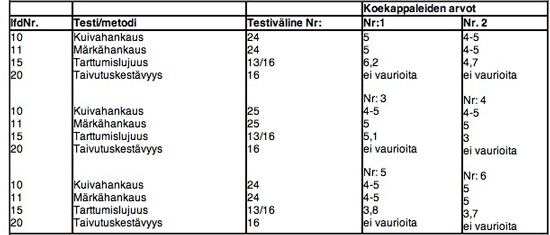
Tested leather type: Princess Grain Flama Specification: GÜTERRICHTLINIE VDL/90 Code: VDL.ZUGER Test plan No: 29 As the numerical values of the test results show, Softcare performed very well in all test types.
Minor changes were found to be temporary, with values returning to normal. T.N.O. Nutrition and Trace Element Laboratory, the Netherlands. Test results: Acute inhalation toxicity of Softcare spray. The test involved 8 rats, four males and four females. They were exposed for 4 hours in a chamber containing airborne Softcare mist at 20.4 plus/minus 0.1 g/m³. The mist concentration based on gravimetric analysis was 105.8 +/- 3.4 mg/cm³. Approximately 94% of the mist particles ranged in size from 1.0 to 4.2 µm. The conclusion was that acute exposure to the aforementioned concentration caused minor changes in lung function and tissue, which were found to be temporary with values returning to normal.
Softcare protectors are suitable for use on leather and textile GoreTex products. Researcher Esben Fhomsen tested the compatibility of Softcare protector with Gore-Tex products at the GoreTex laboratory in Denmark. The test requirements are as follows: 1. The protector must not reduce the product's breathability by more than 20%. 2. After treatment, the product must not absorb more than 20% of its weight in water when immersed for 4 hours. Results after Softcare treatment: 1. Breathability decreased by 4.9%. 2. The product absorbed 10% water. Softcare protectors are suitable for use on leather and textile GoreTex products because Softcare leaves the surface breathable and prevents water absorption into the product.
Softcare does not affect the ignitability and flammability of textiles. Textile fire tests for 100% wool, Trevira CS, and polyester treated with Softcare textile protector, conducted by Finnair's test laboratory. The test method used was FAR 25-32,25,853 b. The tests confirmed that Softcare does not affect the ignitability and flammability of textiles. Test conducted on October 22, 1993, reports 24/93, 25/93, and 26/93.
Both test specimens remained intact after testing. Softcare treatment durability test. Test method: BS5690:1991, pressure 12 kPa. Conducted in November 1997. The test was performed on Hallingdal 2000, FV.750 fabric, with one specimen protected with Softcare Textile Protector and a control specimen without protection. The specimens were subjected to a Martindale abrasion resistance test for 100,000 cycles. Both test specimens underwent the abrasion resistance test of 100,000 Martindale cycles. It was concluded that both test specimens remained intact after testing. The Softcare-treated specimen was subjected to a water repellency test after the abrasion test. The specimen still showed good water repellency. After 100,000 abrasion cycles, Softcare's water repellency had decreased somewhat. Test conducted by DTI Clothing and Textile / Henrik Eigtved, DK.2630 Taastrup.
The product is not toxic in nature. Swedish Fiber and Polymer Research Institute, Department Head Stefan Posner: After reviewing the toxicity and environmental toxicity data and the product safety data sheet, we can provide the following statement:
Non-toxicity The product's LC55 value is >5000mg/kg. This indicates that the product poses no toxicity risk to its user or anyone coming into contact with the product.
Biodegradability has been measured in a 28-day test, which is the OECD standard duration for biodegradability testing. According to the study, over 60% of the product biodegrades within 28 days. This means that the product is biodegradable according to OECD standards. Biological degradability is given as a log Pow value. If this exceeds 3, the product is biologically degradable. For fluorotelomers, this value is 0.3. Based on available data, the product is not toxic in nature. Additional comments: Since the product contains fluorotelomers, attention should be paid to the product's combustion. If a product containing fluorotelomers burns with insufficient oxygen, hydrogen halides may form as combustion products, which are toxic gases. Additionally, it should be remembered that different chemicals have their own usage instructions. Following the manufacturer's usage instructions ensures safe use of the product.

Fill out the application form and we will contact you to discuss the details of our partnership.

We offer training and retail materials for retailers and corporate clients. Please inquire about availability and ordering instructions.
